Wednesday, December 16, 2009

Investigating Trophic Levels with Owl Pellets


Environmental Science students dissected owl pellets to determine what barn owls eat. They identified the different prey species they found using dichotomous keys, and constructed a food web based upon pellet prey analysis. They also performed calculations on cumulative total biomass and determined class prey percentages.

pH Experiment


The ChemCom Class tested the pH of several substances using different kinds of indicator solutions. These solutions change color with different pH values. Here they are blowing into water to produce carbonic acid, which they will test the pH of. Students use microchemistry spot tests to determine pH.

Wednesday, November 11, 2009

Field Trip to Claggett Farm


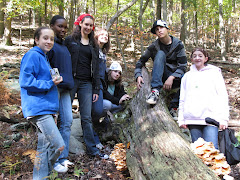
The Environmental Science class went on a field trip to Claggett Farm, Chesapeake Bay Foundation's sustainable farm, on Wednesday, November 4, 2009. The students did the following activities at the farm: studied maps of the Chesapeake Bay watershed, and learned important facts about each type of map; learned the historical background of the farm; did sedimentation studies and found out how ground cover affects water quality; took a walk in the woods and played the "predator-prey" game; did a scavenger hunt in the woods, found several species of leaves and other living things; went on a hay-ride; learned about rotation grazing; visited a greenhouse where CBF grew shitake mushrooms on logs; got to hold baby chickens; and learned how a "chicken tractor" works. The trip was conducted by the Chesapeake Bay Foundation and funded by the Chesapeake Bay Trust.
Thursday, October 15, 2009

Field Trip to Rocky Point and Beyond

Students show a satellite map of the Chesapeake Bay Watershed,
and share what they have learned about it.
Testing the pH of the water.
We are leaving the dock at Rocky Point Park on the Marguerite.
A class picture at the dock in front of the workboat, Marguerite.
On October 13, twenty-six Environmental Science students from Mrs. Barizo's class went on a field trip to Rocky Point Park. At the park, they boarded the Marguerite, a scientific workboat, to do some scientific investigations on the water. Students did map-reading activities, tested the water for phosphates, nitrates, dissolved oxygen, pH, temperature, salinity, and turbidity. They also did a "bottom grab" experiment to see what organisms lived on the benthic zone of the Bay. They trawled for fish in the afternoon and caught a huge carp, a small jellyfish, Bay anchovies, and some white perch. Students also took turns driving the boat on the way back to the dock. It was a fun, productive day of learning activities. The trip was conducted by the Chesapeake Bay Foundation and partially funded by the Chesapeake Bay Trust.

Wednesday, September 23, 2009

New Science Project

We are studying mycology - the study of mushrooms - in Environmental Science this year. Toyota Motors Foundation gave us a large $10,000.00 grant to study mycorrhizal and saprophytic fungi. The funds allow us to purchase digital cameras, real nice microscopes, and several books on mycology. It also covers mileage to different foray sites, so we can actually collect, identify, and study different species of mushrooms. We are also growing several species of edible mushrooms in the lab, and will be inoculating logs with mushroom spawn. We are participating in the annual mushroom fair sponsored by the Mycological Association of Washington DC on Sunday, October 4, where students will exhibit some of their projects on how mushrooms help forest ecosystems and improve the quality of our lives. Please check out our project website at http://sites.google.com/site/hvamycology/home. We will be updating the site regularly.

Wednesday, April 22, 2009

Canoeing at the Monocacy River


On April 8, the Environmental Science class went on an all day canoe trip on the Monocacy River near Buckeystown. The day started out with paddling instructions and map reading. They stopped for lunch at noon, did a macro-invertebrate survey of a small tributary, canoed to the point where the Monocacy meets the Potomac River, and played environmental games. It was a day filled with fun learning experiences. The field trip was conducted by the Chesapeake Bay Foundation and partially funded by Chesapeake Bay Trust.

Forensic Science Labs


Forensic Science students did labs on forensic anthropology, where they examined a set of adult bones (skull, pelvis, femur, and humerus), performed calculations on measurements, and determined the sex, age, height, and race of the skeleton. They also did the same analysis on juvenile bones. Students also did a lab on blood spatter analysis. They made conclusions on possible crime scenarios based on the sizes and patterns of blood spatter.

Field Trip to Phillip Merrill Environmental Center


The Environmental Science students visited the Chesapeake Bay Foundation Headquarters (Phillip Merrill Environmental Center) in Annapolis, MD. They center is known for being environmentally friendly and has won platinum awards for its unique design and for its being a "green" building. The trip was sponsored by the Chesapeake Bay Trust and Target Foundation. Students interviewed employees, toured the building, went on a scavenger hunt, and canoed on Black Walnut Creek. They also did biodiversity studies by seining at the creek.

Thursday, February 5, 2009

Forensic Serology


Forensic Science students are studying a chapter on forensic serology. Here they are trying to determine the blood types and Rh factors of suspects, victims, and "blood" samples from a hypothetical crime scene.

Molecular Models


ChemCom students are studying hydrocarbons. They are shown building models of saturated hydrocarbons, such as butane, pentane, octane, and others. They are also learning how to write structural formulas and electron-dot diagrams of simple hydrocarbons.

Thursday, January 8, 2009

Flame Tests


Chemistry students observed flames from various metal salts in their study of atomic spectra. The colors emitted by flames correspond to frequencies emitted by atoms when electrons are excited to higher energy levels, and may be used to identify metal atoms.

Ink and Document Analysis


Forensic Science students recently did a lab on ink and document analysis. They examined pencil marks using microscopy, and analyzed ball point and felt pen inks using paper chromatography. They also compared various paper samples using ultraviolet light. At the conclusion of the lab they were asked to identify three unknowns from a hypothetical crime scene.