Sunday, November 23, 2008
Field Trip to Clagett Farm


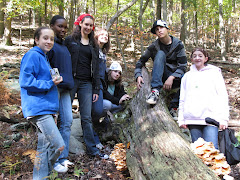
The Environmental Science class went on a field trip to Clagett Farm on November 6, 2008. Clagett Farm is Chesapeake Bay Foundation's sustainable farm. Students did sedimentation studies, planted cover crops, learned about rotation grazing and community supported agriculture, played environmental games, fed the cows, went on a hayride, and played a scavenger hunt in the woods. One of the favorites of the students was a tree with a large hole in the trunk named Sally Sycamore. They took turns trying to fit as many people in the hole. The trip was partially funded by the Chesapeake Bay Trust.
Wednesday, November 12, 2008
Thursday, October 23, 2008
Baltimore-to-the-Bay Field Trip


On October 13, the Environmental Science class went on a field trip to Rocky Run Park near Baltimore. They spent the day on the Marguerite, Chesapeake Bay Foundation's scientific work boat, where they learned to read navigational maps, performed water quality tests of Chesapeake Bay water, trawled for fish, and did biodiversity studies. They also canoed on the Bay and the river and seined for marine life on the shores of the Bay. They learned how human activities had a significant impact on the water quality of the Chesapeake Bay. The trip was funded by a grant from the Chesapeake Bay Trust.
Elements, Compounds, and Mixtures


Chemistry students performed several experiments on properties of elements, compounds, and mixtures. They observed reactions between vinegar and baking soda, copper chloride solution with aluminum, and electrolysis of water. They also separated components of mixtures using several techniques. Here they are observing the electrolysis of water into hydrogen gas and oxygen gas.
Sunday, October 12, 2008
Site Maps
Graphical Determination of Density
Biosphere 3


Environmental Science students did a group project called "Biosphere 3." They designed a self-contained, energy-efficient, closed system on a location of their choice. They had to make a diagram of their biosphere; make lists of occupants and roles, and items that needed to be brought into the biophere; and had to design waste and recycling systems, since they could not exchange any matter with their surroundings. Groups then shared their project with their classmates. They learned that teamwork is absolutely important, not only in a project, but also in real life.
Wednesday, September 10, 2008
Measurement Lab - SI System


Chemistry and ChemCom students are studying the SI (International System) of units, the main system used in scientific investigations. It is also called the metric system. They have been getting some practice in distance, volume, and mass measurements in the lab to prepare them for doing quantitative scientific experiments.
Subscribe to:
Comments (Atom)